
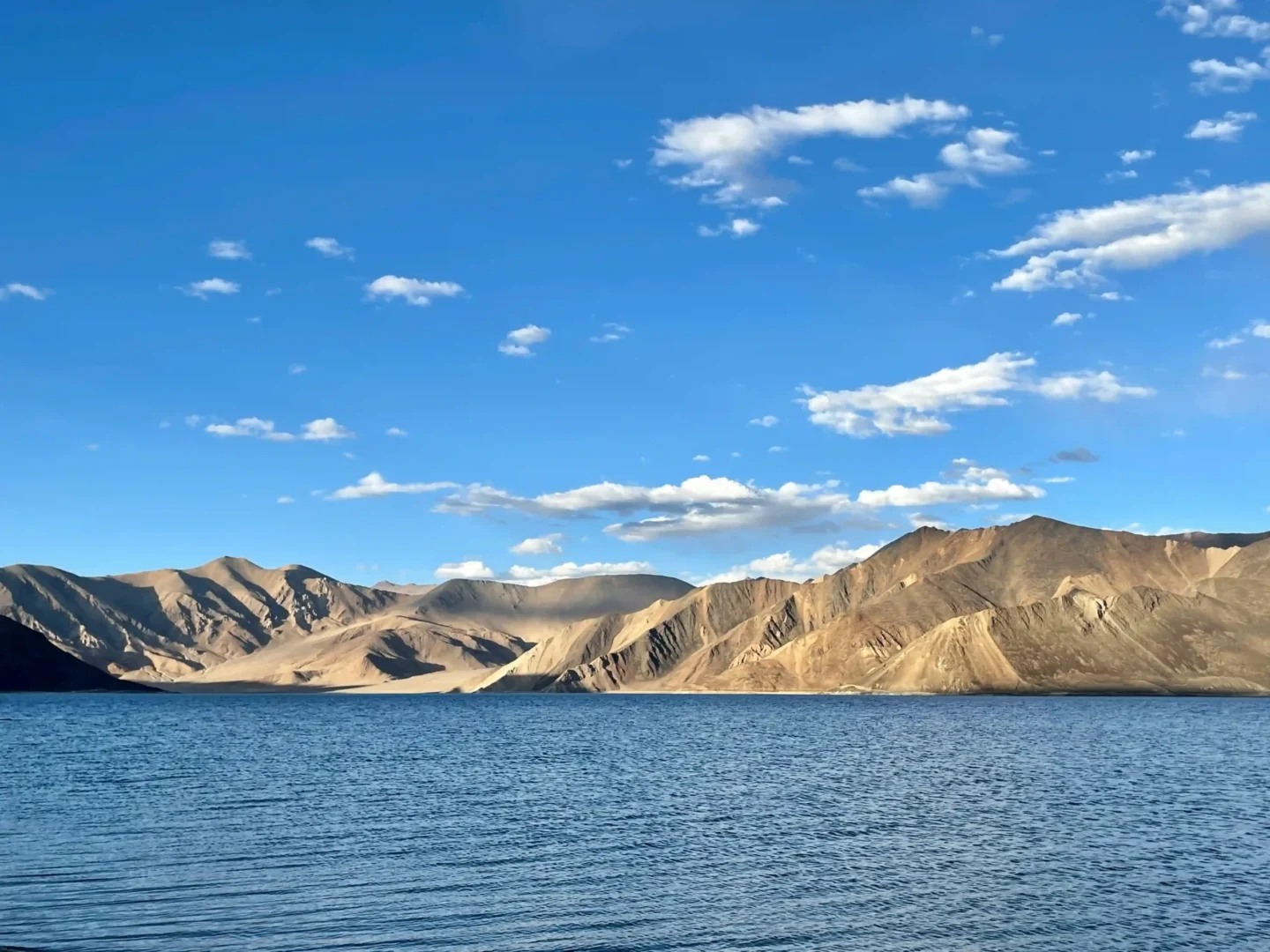
Pangong Lake Ladakh: Complete Travel Guide 2026
If you’ve typed “Pangong Lake Ladakh” into Google, you’ve probably already seen the same photo of impossibly blue water a hundred times over — and most Pangong Lake Ladakh content out there stops at the postcard shot. What most pages won’t tell you is how physically demanding the drive actually is, what the permit process looks like this year, or why rushing straight from Leh to the lake sends more tourists back down with altitude sickness than almost any other stretch of road in Ladakh. We’ve driven this route with guests more times than we can count, so this guide skips the poetry and gives you what you actually need before you go.
Where Pangong Lake Ladakh Actually Is
Pangong Lake Ladakh — locally called Pangong Tso, from the Tibetan words for “high grassland” and “lake” — sits in the Changthang region of eastern Ladakh, right along the India–Tibet border. It stretches roughly 134 km in length and up to 5 km at its widest point, sitting at an altitude of about 4,350 metres (14,270 ft). Only around a third of the lake lies within Indian territory; the rest runs deep into Tibet. It’s one of the highest saltwater lakes in the world, and despite the salinity, it freezes completely in winter.
Leh to Pangong Lake Ladakh Distance and Route
This is the question we get asked most about Pangong Lake Ladakh, and the numbers genuinely vary depending on which source you check — so here’s the range you’ll actually encounter. The distance from Leh to Pangong Lake is roughly 160 km via the standard route, taking about 5–6 hours by road, though some routings via Durbuk push the total closer to 220 km depending on the exact village you’re headed to (Spangmik, Man, or Merak).
The classic route runs: Leh → Shey → Thiksey → Karu → Chang La Pass → Durbuk → Tangtse → Pangong Lake. Chang La sits at roughly 5,360 metres — higher than Pangong Lake itself — and is one of the highest motorable passes anywhere, complete with army checkpoints where your permits get checked. The road is generally in decent shape with a few rough patches around Chang La and just past Tangtse.
If you’re doing the full Ladakh circuit rather than an out-and-back trip, an alternative route runs through Nubra Valley via the Shyok River road, connecting Pangong without a return to Leh in between. It’s a rougher, more adventurous drive and adds real time, but it saves you from backtracking. For the full logistics on this side of the journey, our guide on Srinagar to Leh road trip and permit details is worth reading before you finalize your route.
This road is generally open from May to early October, depending on snowfall — outside that window, Chang La can close entirely.
Permits Required for Pangong Lake Ladakh
Because Pangong Lake Ladakh sits in a restricted border zone, every visitor needs a permit — this isn’t optional, and checkpoints do enforce it.
- Indian nationals need an Inner Line Permit (ILP), obtainable online through the Ladakh government portal or in person at the Leh DC office. Carry a valid photo ID when applying.
- Foreign nationals need a Protected Area Permit (PAP), which must be arranged through a registered tour operator — you can’t apply for this one independently.
- If your itinerary also covers Nubra Valley, you’ll need that permit added separately, since it isn’t automatically bundled with the Pangong ILP.
If you’re booking a Leh Ladakh tour package with us, permits for Pangong Lake Ladakh are handled as part of the trip rather than something you have to chase down yourself between hotel check-ins.
Best Time to Visit Pangong Lake Ladakh
- May to September is the standard window — roads are open, weather is manageable, and the lake is at its most vivid blue.
- July–August is peak season, meaning the best weather but also the most crowds and the highest prices for stays near the lake.
- September is quietly the best month for photography — clearer skies, fewer tourists, and the surrounding hills starting to turn gold.
- January–February, if you’re chasing something different, is when the lake freezes over completely — a genuinely different, starker kind of beautiful, though this trip is only for well-prepared, cold-weather-experienced travellers given the extreme temperatures and limited road access.
Altitude and AMS: The Part Most Guides Skip
This is the single most important section on this page, so we’re not burying it. Chang La Pass sits higher than Pangong Lake Ladakh itself, which means the drive from Leh involves a rapid ascent well above 5,000 metres before you even reach the lake. Acute Mountain Sickness (AMS) is the leading reason trips to Pangong Lake get cut short.
- Spend a minimum of 2 full days acclimatising in Leh (3,505m) before attempting the drive. This is not a suggestion you can skip to save time.
- Mild symptoms — headache, mild nausea, fatigue — are common on day one and usually manageable with rest, hydration, and paracetamol.
- Moderate symptoms — severe headache, vomiting, difficulty walking — mean you descend to lower altitude immediately, no exceptions.
- Severe symptoms — confusion, inability to walk straight, chest tightness — are a medical emergency. The nearest help is in Tangtse (about 50 km away) or back in Leh.
- Drink 3–4 litres of water a day once you’re in Ladakh, and skip alcohol entirely for your first 48 hours — it makes AMS meaningfully worse.
For a full packing rundown that accounts for the altitude, wind, and temperature swings, our complete packing list for high altitude Ladakh trips covers exactly what to carry.
Where to Stay Near Pangong Lake Ladakh
Most travellers stay in one of a handful of small settlements along the lake’s edge:
- Spangmik — the closest and most popular base, with the widest range of camps and cottages.
- Man and Merak — quieter villages a little further along the lake, better if you’d rather skip the crowds around Spangmik.
- Lukung — closer to the Chang La side, a common stop for shorter visits.
Accommodation ranges from basic tented camps to slightly more comfortable cottages — don’t expect luxury this close to the border, but do expect some of the clearest night skies you’ll see anywhere in India. An overnight stay is genuinely worth prioritising over a rushed day trip, since sunrise and sunset over the lake (and the stargazing in between) are a large part of why people come here in the first place.
Day Trip vs. Overnight Stay at Pangong Lake Ladakh
A day trip to Pangong Lake Ladakh from Leh is possible but exhausting — you’re looking at 10–12 hours on the road for a few hours at the lake, and you’ll miss the sunrise, sunset, and star-filled sky that make Pangong genuinely memorable. We’d steer most travellers toward at least one overnight stay unless your schedule genuinely won’t allow it.
Sample 2-Day Pangong Lake Ladakh Itinerary
Day 1: Depart Leh by 6–7 AM, driving via Shey, Thiksey, and Karu toward Chang La Pass. Cross into Durbuk and Tangtse, arriving at Spangmik by early afternoon. Spend the rest of the day at the lake, watching the colours shift as the sun moves, followed by an overnight stay in a lakeside camp.
Day 2: Catch sunrise over the water before breakfast, then either return to Leh the same way, or continue on toward Nubra Valley via the Shyok route if you’re doing the full circuit.
If you’d rather have this entire Pangong Lake Ladakh trip — permits, acclimatisation days, and route — planned and driven for you, our Leh Ladakh Tour Packages build Pangong into a properly paced itinerary rather than a rushed side trip. For shorter windows, the Ladakh 4 Nights 5 Days Tour Package and Ladakh 5 Nights 6 Days Tour Package both include Pangong and Nubra. If you have more time, the 7 Nights 8 Days Ladakh Tour Package adds Tso Moriri into the same circuit.
Travelling as a Group or on a Budget
If you’re organising a larger group trip, our Leh Ladakh Group Trip Package Cost page breaks down per-person pricing clearly. If comfort matters more than cost, the Leh Ladakh Luxury Tour Package covers the 5-star version of this same circuit. And if you’re planning this trip on a tighter budget, our guide on Ladakh on a budget: a complete 10-day plan is a realistic starting point.
Getting the Wider Picture
Pangong Lake Ladakh is usually one stop within a bigger Ladakh loop rather than a standalone destination. Our broader guide to Ladakh road trips and high-altitude routes shows how Pangong connects with Nubra Valley, Khardung La, and the rest of the region, so you can see where it fits into a longer itinerary. And if it’s the view itself you’re after before you commit to the logistics, our earlier piece, Pangong Lake: The Blue That Defies Reality, captures what it’s actually like standing at the water’s edge.
Frequently Asked Questions
How far is Pangong Lake from Leh?
Roughly 160 km via the standard Chang La route, taking about 5–6 hours by road. Stays in further villages like Man or Merak add another 20–30 km to the journey.
Do I need a permit to visit Pangong Lake?
Yes. Indian nationals require an Inner Line Permit (ILP), obtainable online or via the Leh DC office. Foreign nationals need a Protected Area Permit (PAP) arranged through a registered local tour operator.
What is the best time to visit Pangong Lake?
May to September is ideal, with July–August serving as peak season and September offering clearer skies and lighter crowds. Winter travelers visit in January–February to see the lake completely frozen.
Is Pangong Lake safe from altitude sickness (AMS)?
It requires proper precautions. Spend at least 48 hours acclimatizing in Leh before traveling, as crossing Chang La Pass (5,360 m) involves a steep ascent that can trigger altitude sickness if rushed.
Can I do a day trip to Pangong Lake from Leh?
Yes, but it requires 10–12 hours of driving round-trip for just 2–3 hours at the lake. An overnight stay is strongly recommended to experience sunset, sunrise, and stargazing.
Ready to plan your Pangong Lake Ladakh trip? Explore our full Leh Ladakh Tour Packages, browse all destinations, or reach out directly on WhatsApp at +91 84920 85895 — we’ll build your Pangong Lake Ladakh itinerary around proper acclimatisation, not a rushed checklist.