
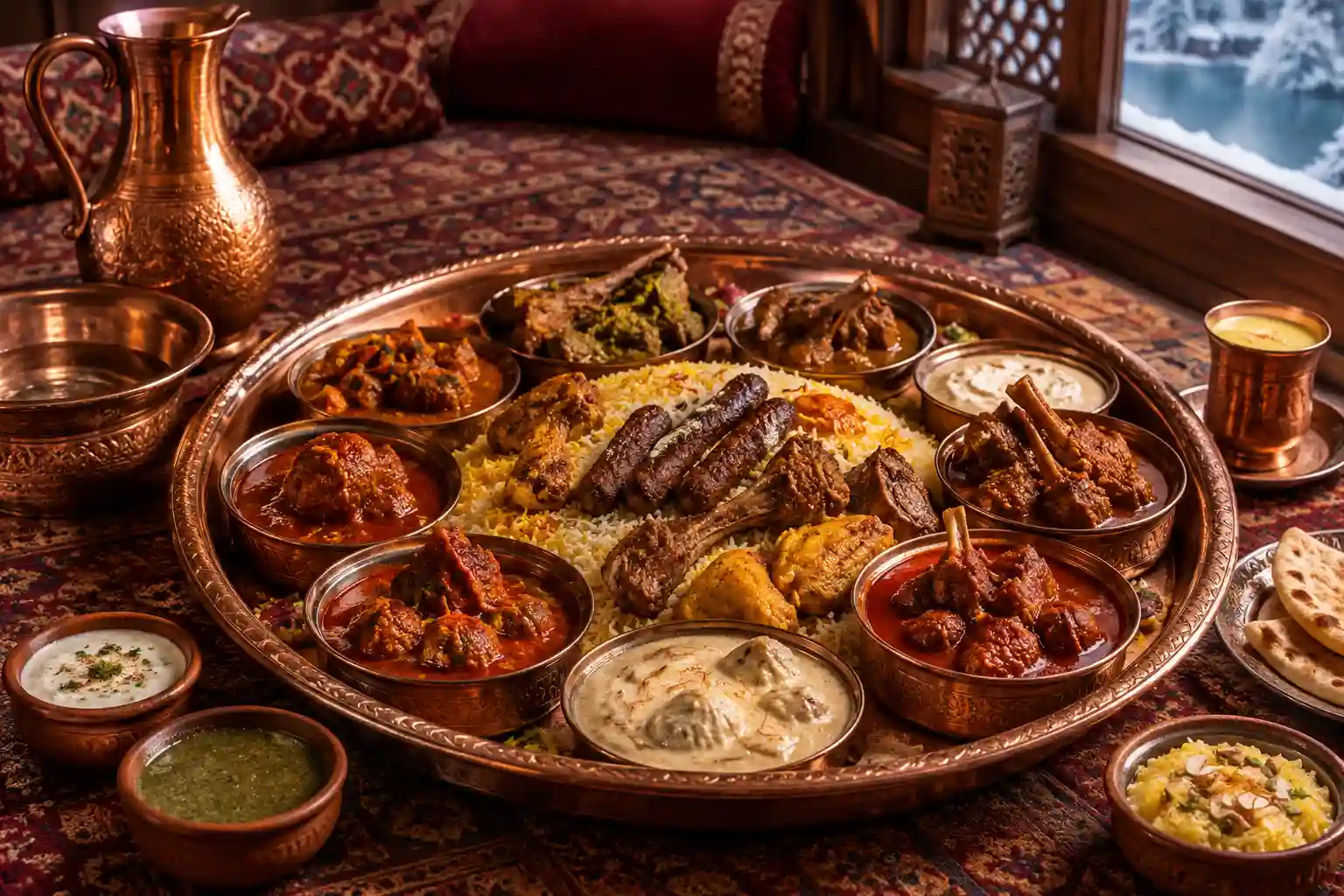
What is Wazwan? It is Kashmir’s grand feast: many courses of slow-cooked meat, served on one big copper plate and shared by four people. Locals serve it at weddings and big family events. Visitors can eat a shorter version in Srinagar restaurants, on houseboats and in some hotels.
We are a local team in Srinagar, and we arrange Wazwan dinners for guests every year. This guide explains what is Wazwan, how it is served, what each course is, what it costs, where to eat it and how to enjoy it on a winter trip. It also covers halal, vegetarian and foreign-guest notes. If you want a wider view of Kashmiri food, read our Kashmir cuisine guide too.
What Is Wazwan? A Simple Answer
So, what is Wazwan? It is a ceremonial multi-course meal from the Kashmir Valley. The word comes from “waza”, a cook, and “wan”, a shop. Almost every dish is meat, mostly lamb or mutton, with some chicken. Every dish is made to halal standards, which answers a common part of what is Wazwan for Muslim guests.
Three things make Wazwan different from a normal restaurant meal:
- It is a shared meal. Four guests sit together and eat from one large copper plate called a trami.
- It has a fixed order. The courses come in a set sequence, and the meal ends with a famous dish called gushtaba.
- It is cooked by specialists. The cooks are called wazas, and a master chef, the vasta waza, leads them.
You will often hear that Wazwan has 36 courses. That number is the royal, full version. A review in the Journal of Ethnic Foods puts the range at 7 to 36 dishes, so do not trust anyone who says every Wazwan has 36. The Wazwan you order in a restaurant is normally a shorter version of the wedding feast.
What Is Wazwan’s History?
The story usually begins in the fifteenth century. Skilled craftsmen, builders and cooks came to Kashmir from Samarkand in Central Asia after Timur’s invasion. They mixed Central Asian cooking with Kashmir’s own spices and ingredients. Their descendants are the wazas, the master cooks of the Valley.
As SBS reports, part of the beauty of Wazwan is the way one animal gives many different dishes. The dishes need hours of work, and many are cooked overnight.
Wazwan is also a social event. A family calls the waza first when it plans a wedding. The waza and his team then take over the kitchen. People of all faiths in Kashmir love it. Kashmiri Pandit homes have their own style and dishes. Kabargah, for example, is the Pandit version of a dish close to tabak maaz. But the shared plate is the same idea.
What Is Wazwan Served On?
The trami is a large copper platter. Before the meal, attendants bring a basin and jug called the tash-t-nari, so each guest can wash hands. Then the tramis arrive.
A trami for four starts with a heap of rice. On top sit four seekh kebabs, pieces of methi maaz, tabak maaz and some chicken dishes. Yoghurt and chutney come separately in small earthen pots. When the first trami is finished, an attendant takes it away and another one arrives with the next courses, until the meal ends.
Guests sit cross-legged on the floor at a feast. In restaurants, you sit at a table, but the plate and the sharing stay the same.
What Is Wazwan Made Of? The Main Dishes
So what is Wazwan made of, in practice? The meal changes by family and cook, but a few dishes appear almost every time. Many Kashmiris say seven dishes are a must: rista, rogan josh, tabak maaz, daniwal korma, aab gosht, marchwangan korma and gushtaba.
Here is what each one is:
- Seekh kebab: Minced meat on skewers, usually among the first dishes on the trami.
- Tabak maaz: Lamb ribs cooked in milk and spices, then fried until crisp outside and soft inside.
- Methi maaz: Lamb cooked with fenugreek leaves.
- Rista: Smooth meatballs in a deep red gravy coloured and flavoured by Kashmiri chilli.
- Rogan josh: Tender lamb in a red gravy with Kashmiri spices. It is the dish most visitors have heard of.
- Daniwal korma: Lamb in a coriander-based gravy.
- Marchwangan korma: A fiery red lamb curry made with dried Kashmiri chillies.
- Aab gosht: Lamb cooked in milk and spices. It is mild and rich.
- Waza kokur: Chicken cooked whole in two halves.
- Gushtaba: Large pounded meatballs in a yoghurt gravy. It comes last among the main dishes.
Traditional Wazwan cooking avoids tomato and uses little or no onion, and the red colour of many dishes comes from Kashmiri chilli and a flower called mawal. Saffron, fennel and dry ginger flavour many others.
What Is Wazwan’s Order of Courses?
Order matters. A rough sequence looks like this:
- Hand washing at the table
- Rice, kebabs and the first dry dishes (seekh kebab, tabak maaz, methi maaz)
- Chicken dishes such as safed murg and zafrani murg
- Gravies such as rista, rogan josh, daniwal korma and aab gosht
- Gushtaba as the grand finale of the meat dishes
- Sweets and kahwa, the saffron tea
At a wedding feast, the most honoured guest, often the groom, is the one who breaks the gushtaba. You do not need to follow that rule in a restaurant, but it explains why the dish comes last.
What Is Wazwan Compared with Everyday Kashmiri Food?
Wazwan is the festival version. Everyday Kashmiri food is simpler. At home, families eat rice with vegetable dishes such as haak, nadru yakhni and dum aloo, with a little meat. Wazwan is the opposite: meat comes first, in great variety, and it is made for guests. So when someone asks what is Wazwan compared with a normal Kashmiri dinner, the answer is occasion, scale and ritual. You can taste both in Srinagar, and we suggest trying one Wazwan dinner and one home-style meal on the same trip. Our Kashmir cuisine guide covers the everyday dishes, bread, tea and sweets.
What Is Wazwan Etiquette? How to Eat It
You eat Wazwan with your hands. A restaurant will give you a spoon or fork on request, so do not feel nervous about it. A few easy tips help.
- Wash your hands first. The basin is part of the ritual.
- Share the plate. Take food from your side, and pass dishes along.
- Start light and go slow. The meal is very rich. Do not fill up on rice and kebabs.
- Use the bread and yoghurt. Kashmiri bread helps scoop up gravy, and curd cools the heat.
- Leave gushtaba for the end.
Eating the whole trami for four is hard. Many couples order a smaller set or two or three dishes. Ask the waiter what the set includes before you order.
What Is Wazwan’s Best Order for a First-Timer?
You do not need the full banquet. Here is a simple plan for two or four people on a first visit.
- Start: Seekh kebab and tabak maaz. They are dry, rich and easy.
- Middle: Rogan josh and one hot dish, either rista or marchwangan korma. Add daniwal korma if you want something mild.
- Finish: Gushtaba, then kahwa.
- Skip: Extra rice and heavy sides. Save space for the courses that matter.
If you ask what is Wazwan’s most famous dish, most people say rogan josh. If you ask which one locals love most, many say gushtaba, tabak maaz or rista. Try all three.
What Is Wazwan Like in Winter?
If you ask what is Wazwan best for, the answer is cold weather. Winter is the best season for it. The meal is heavy, hot and rich, and it suits freezing nights. Many guests say a Wazwan dinner in Srinagar after a day in Gulmarg is their best memory of a snow trip.
A few winter points:
- Plan the day around it. Daylight ends around 5 pm, and a Wazwan dinner is a good reason to go back to Srinagar early.
- Book ahead for festive dates. From 21 December to 10 January, restaurants fill up.
- Pair it with kahwa. The saffron and almond tea warms you after the meal.
- Try winter breakfasts. Harissa, a slow-cooked meat dish sold in the old city on cold mornings, is a seasonal treat. It is sold only in winter.
Our Kashmir in winter guide explains the season in full. You can also read our guides to Kashmir in December and Kashmir in January. The coldest weeks, called Chillai Kalan, run from 21 December 2026 to 31 January 2027, and our Chillai Kalan guide explains how they affect travel.
What Is Wazwan Cost? Indicative Prices
Prices vary by restaurant, season and the size of the set. Here is what we see in 2026 when guests ask what is Wazwan likely to cost, as a guide only.
- Per person: About Rs 800 to Rs 1,500 for a restaurant Wazwan spread.
- Per trami for four: About Rs 3,000 to Rs 5,000. One popular Srinagar restaurant listed its Wazwan trami at Rs 4,800 on its online menu in September 2026.
- Single dishes: About Rs 250 to Rs 650 each when ordered separately.
- Houseboat or hotel dinner: Priced separately. We give you a quote when you ask.
Two tips will save you money. First, ask the price per trami before you order. Some guests report that Wazwan prices are not printed on the menu, and tourist prices can differ. Second, if you are two people, compare a shared trami with two or three single dishes. Three dishes can cost less than a full trami.
Where to Eat Wazwan in Srinagar
Several places are well known for it. Check current timings and prices before you go.
- Ahdoos, Residency Road: An old, much-loved name for Kashmiri food. Many visitors call it a good place to try wazwan dishes.
- Mughal Darbar, Residency Road: Open since 1972, with a wide menu. Reviews are mixed on price, so ask first.
- Shamyana, Boulevard Road: A popular stop for tour groups, with a wide menu.
- Houseboat dinners: Some houseboats can prepare a Wazwan set with notice, and it is a great way to eat in winter, in a heated dining room.
For the real wedding experience, the food is cooked on firewood overnight by a waza, and guests rarely get to see it. A restaurant or houseboat version is the practical choice for visitors.
If you stay on Dal Lake, ask about Wazwan at our houseboat partners. See our heritage houseboat stay on Dal Lake and our Dal Lake luxury houseboat packages. Houseboats can be cold in January, so ask about heating before you book.
How to Get Wazwan Arranged on a Tour
Guests often ask us what is Wazwan like on a package trip. We can add a Wazwan dinner to most plans. Tell us when you book, and we will do the rest:
- Book a table at a restaurant, usually for the evening of your Srinagar night
- Ask your houseboat or hotel to prepare a Wazwan set with a day’s notice
- Tell the kitchen about allergies, spice level and dietary needs
- Quote the price before you confirm, so there is no surprise at the table
Wazwan fits well into our 4 nights 5 days Kashmir tour package and our 3 nights 4 days Kashmir tour package. For a slower, food-friendly trip, see our 5 nights 6 days family package and our Kashmir family tour package with price. If you want a special dinner with premium stays, our luxury Kashmir tour packages cover that, and our customized Kashmir holiday packages let you shape the route yourself.
What Is Wazwan for Vegetarians and Pure Veg Travellers?
Be honest with yourself about what is Wazwan: it is a meat feast. If you are pure vegetarian or Jain, a traditional Wazwan is not the right meal for you. That said, vegetarian dishes are easy to find in Kashmir.
- Modur pulao, a sweet, saffron-scented rice dish, and vegetable pulao
- Waza heddar (mushroom) and ruwangan tchama (paneer in a tomato gravy), now served at some Wazwan dinners
- Dum aloo and haak, the local leafy green
- Nadru yakhni, lotus stem in a yoghurt gravy. If the menu just says “yakhni”, ask whether it contains meat.
Many Kashmiri gravies use yoghurt, so strict vegans will need to plan ahead. Tell us when you book, and we will arrange vegetarian or Jain-friendly dinners in Srinagar and Gulmarg hotels.
What Is Wazwan for Foreign Travellers?
We host guests from the Gulf, the UK, the US, Australia and Malaysia. Many ask what is Wazwan before they land, so here are the key points.
- Halal: Wazwan is made to halal standards, and meat in Kashmir is almost always halal. Alcohol is hard to find.
- Cutlery: Restaurants will give you a spoon and fork. You can also eat with your hands, as locals do.
- Spice: Rista and marchwangan korma are hot. Ask for milder dishes if you are not used to chilli.
- Allergies: Many dishes contain dairy, nuts or saffron. Tell the kitchen early.
- Money: Foreign cards often fail in smaller shops and restaurants. Carry cash in rupees.
- Water and stomach: Drink bottled water and start with a light first course.
- Visa: You need a valid Indian visa. Apply on the official Indian e-visa site.
Our guide for foreign tourists in Kashmir covers arrival, ID and payments. Check J&K Tourism for official travel notices before you go.

Plan a Wazwan Dinner on Your Kashmir Trip
Now you know what is Wazwan and where to eat it. Planning a snow trip? See our Kashmir winter tour packages with clear prices and payment terms, or send us your dates and we will reply with a quote.
Our payment terms are simple. Pay 25% to confirm, 50% by 20 to 29 days before departure, and the balance 20 days before. Cancellation fees rise as the date gets closer. You can read what past travellers say on our Google Business profile. To know who you will travel with, read about our local tour operator in Srinagar. For more planning help, our ultimate Kashmir travel guide 2026 and the top 30 Kashmir travel FAQs are good next reads.
Frequently Asked Questions
What is Wazwan in simple words?
Wazwan is Kashmir’s ceremonial feast of many meat courses, served on a shared copper plate called a trami and cooked by master cooks called wazas.
How many courses are in Wazwan?
The royal version has up to 36 courses. Real feasts range from about 7 to 36, and restaurant sets are shorter.
Is Wazwan halal?
Yes. Wazwan is prepared to halal standards, and meat in Kashmir is almost always halal.
Can vegetarians eat Wazwan?
A traditional Wazwan is a meat feast. Vegetarian dishes such as modur pulao, mushroom and paneer dishes, dum aloo and nadru yakhni are available, and we can arrange a vegetarian dinner.
How much does Wazwan cost in Srinagar?
About Rs 800 to Rs 1,500 per person in a restaurant, and about Rs 3,000 to Rs 5,000 for a trami for four. Ask the price before you order.
What is Wazwan’s last dish?
Gushtaba, a large meatball in yoghurt gravy, is the grand finale of the main dishes.