
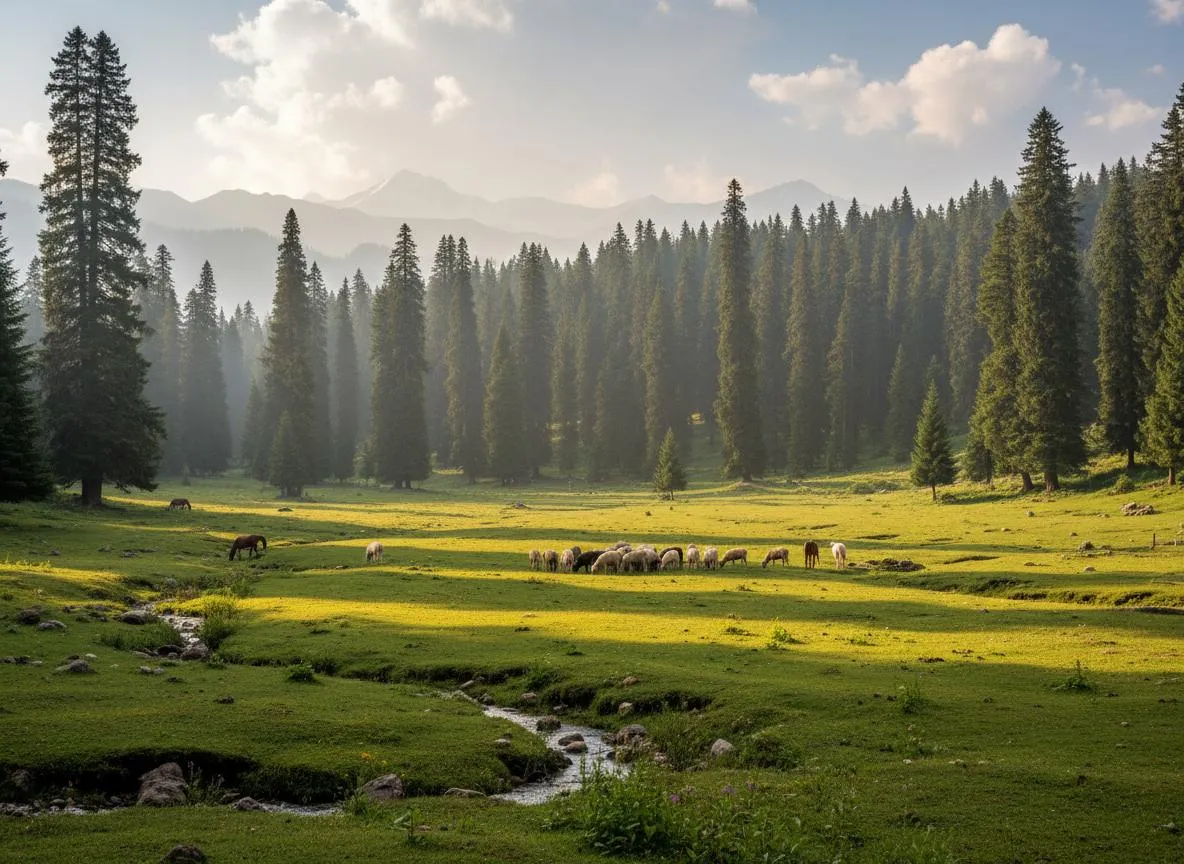
Complete guide to Lolab Valley offbeat tourism is the right place to begin if you want the quiet, green side of North Kashmir that most visitors never see. Often called the “Land of Love and Beauty,” Lolab Valley is a long oval of pine forest, cold streams, walnut trees, rice fields and open meadows in Kupwara district, far away from the crowds of Gulmarg and Pahalgam. If you want a peaceful Himalayan escape, this complete guide to Lolab Valley offbeat tourism covers the roads, villages, seasons, stays, food and safety notes you need for a trip you will actually remember.
We are a Srinagar-based local team, so everything below comes from how this route is really run on the ground, and it is checked against public sources such as the Wikipedia entry on Lolab Valley and the Kupwara district website. Our aim is simple: make this the most useful complete guide to Lolab Valley offbeat tourism you will read before you book. You can also see what past guests say about us in our Google Business Profile reviews.
The Ultimate Complete Guide to Lolab Valley Offbeat Tourism
Lolab Valley is an oval-shaped valley in Kupwara district of Jammu and Kashmir. Public sources describe it as roughly 24 km long, with a valley floor at about 1,665 m (5,464 ft) above sea level. A good complete guide to Lolab Valley offbeat tourism has to start with this geography, because it explains the feel of the place: a long, protected bowl with forest on the slopes, orchards and rice fields on the floor, and small villages tucked between them.
Unlike the famous hill stations, Lolab has no cable car queues, no pony touts and no wall of souvenir shops. Time moves slowly here. Mornings begin with mist over the paddy fields, afternoons belong to forest walks, and evenings end early with a hot cup of noon chai and a quiet village sky full of stars.
That quiet is the reason travellers look for a complete guide to Lolab Valley offbeat tourism in the first place. If you have already done the classic loop and want a different side of the region, our list of offbeat places in Kashmir shows where Lolab fits among the other quiet corners.
Lolab Valley Quick Facts: Complete Guide to Lolab Valley Offbeat Tourism at a Glance
Here is what a good complete guide to Lolab Valley offbeat tourism should tell you in the first minute.
Short answer: Lolab Valley is about 100 to 115 km from Srinagar, a drive of roughly 3 to 4 hours, and it is best from April to October. Two nights is the sweet spot. Tap the WhatsApp or call button on this page and our local team will plan it for you.
Foreign guests welcome: We host overseas visitors on North Kashmir trips. Message us your passport country and dates before booking, because access rules in border districts can change.
| Quick fact | Details |
|---|---|
| District | Kupwara, North Kashmir |
| Distance from Srinagar | About 100 to 115 km, depending on the route and the village you are heading for |
| Driving time | Roughly 3 to 4 hours by road from Srinagar via Sopore and Kupwara |
| Valley floor height | About 1,665 m (5,464 ft) |
| Best months | April to October, with a snowy, very quiet winter |
| Main hubs | Sogam, Chandigam, Kalaroos and Diver |
| Ideal trip length | Two nights; one day is possible but rushed |
When you plan the logistics, check official regional information through the Jammu and Kashmir Tourism Development Corporation for the latest tourist rest house details. For a trip with permits sorted, a driver who knows the side roads and comfortable stays, coordinate with an experienced local operator like Travel Nerve Kashmir so nothing is left to chance. Every honest complete guide to Lolab Valley offbeat tourism should say this plainly: the valley is easy to love, but it is not a place to improvise.
How to Reach Lolab Valley from Srinagar
Every complete guide to Lolab Valley offbeat tourism should be honest about the road. You first reach Kupwara town, and the valley entrance lies only a few kilometres beyond it. The drive from Srinagar runs through Sopore and Handwara. Sources quote different distances and times because the valley is long and people measure to different villages, so plan for three to four hours of driving with a tea stop, more if there is traffic or road work.
The simplest way is a private car with a local driver. Shared sumos and buses do run towards Kupwara, but moving between villages inside the valley is hard without your own vehicle, because the distances between Sogam, Chandigam and Kalaroos add up. A private taxi also lets you stop for photos at orchards and streams, which is half the joy of the trip.
This is how our complete guide to Lolab Valley offbeat tourism compares the transport options:
| Option | What to expect |
|---|---|
| Private car with driver | Most flexible; the only easy way to move between villages |
| Shared sumo or bus to Kupwara | Cheap, but you will still need local transport inside the valley |
| Self-drive | Possible, but narrow hill roads and border checks make a local driver the safer choice |
This complete guide to Lolab Valley offbeat tourism avoids fixed promises on the road. Some reports mention a new road from Bandipora to Lolab via the Nagmarg meadows that would shorten the journey. Treat this as a “check before you go” item rather than a promise, and ask us for the current road status before you travel.
Because Lolab is in a border district, carry an original photo ID for every traveller, and expect routine police and army checks on the road. They are normal and quick if your papers are in order. If you want to avoid the busiest roads on your way back, our guide on how to avoid tourist crowds in Kashmir has useful timing ideas.
Exploring the Main Regions: Chandigam, Diver, Sogam and Kalaroos
The valley is traditionally spoken of in two natural halves, Poutnai and Brunai, with Kalaroos forming its own pocket on the far side. For visitors, though, it is easier to think in terms of three main hubs: Chandigam, Diver and Sogam. As you read any complete guide to Lolab Valley offbeat tourism, these are the names you will see again and again.
Sogam is the largest village and the administrative centre of the valley. It is where you find the basic shops, the market and the main road junctions. Use it for cash, supplies and fuel before you go deeper, a practical point that every complete guide to Lolab Valley offbeat tourism should repeat.
Chandigam is the calm heart of the valley. Surrounded by deodar and pine and framed by mountains, it is the village most travellers remember. The JKTDC tourist rest house here makes it the easiest base for first-time visitors, and the walks around the village are gentle enough for families.
Diver is the place for green meadows and camping. It is also the doorway towards the higher forests and the Nagmarg meadow area for those who like walking uphill and sleeping under canvas.
Kalaroos sits on the Kupwara to Machil road and is the base for the famous caves and for the climb to Satbaran. In a complete guide to Lolab Valley offbeat tourism, Kalaroos always earns a half day of its own.
For structured plans that link these villages without logistical hassle, explore every plan we run, or ask for our Kashmir offbeat tour package for 6 nights and 7 days if you want Lolab combined with other quiet corners of the valley.
Key Attractions and Hidden Gems in Lolab Valley
Keep this complete guide to Lolab Valley offbeat tourism open while you travel, because the best spots here are quiet and sometimes unmarked.
- Kalaroos Caves: Ancient stone caves wrapped in local folklore. Villagers say secret tunnels from here once ran all the way to Russia, which is a legend rather than a fact, but it makes for a fun story on the walk.
- Satbaran: A huge rock above Kalaroos village with seven door-like carvings in a row. It is reached by a forest track and rewards you with a wide view of the whole valley, so wear proper shoes.
- Lavnag spring: A clear natural spring near Lalpora, close to the resting place of the saint Kashyap Reshi. It is a peaceful stop for a short walk and a drink of cold water.
- Putushai village: A scenic hamlet known for terraced fields and views of the surrounding mountains.
- Nagmarg camping area: A high meadow above Diver, popular with campers who want a night away from every village light.
- Orchards and walnut groves: In spring and autumn, a simple walk through village lanes is a highlight on its own.
Together these spots show why a complete guide to Lolab Valley offbeat tourism is worth reading before you pack.
Discover North Kashmir’s hidden valleys
Let local experts guide you safely through Lolab, Kupwara and Bangus Valley with trusted drivers and homestays. View our Kashmir offbeat circuit plan or ask for a custom offbeat tour.
Ideal Weather and Seasons for a Complete Guide to Lolab Valley Offbeat Tourism
Timing is everything in any complete guide to Lolab Valley offbeat tourism. Summer, from May to September, brings pleasant days of roughly 15°C to 25°C, bright green meadows and clear skies, which makes it the best window for families, camping and slow exploring.
| Season | What you get |
|---|---|
| Spring (April to May) | Apple, cherry and plum blossoms cover the orchards. The air is fresh, the crowds are almost zero, and photographers love this season. |
| Summer (June to August) | The easiest months for trekking to Satbaran and Nagmarg. Afternoon showers are possible, so carry a light rain jacket. |
| Autumn (September to October) | Gold and amber on the walnut and chinar trees, harvest in the fields and crisp mornings. Many local guides call this the most beautiful season. |
| Winter (November to March) | Cold and snowy, with a very quiet, snow-clad valley. Roads can be slow after snowfall, and some stays may close. |
Winter, in this complete guide to Lolab Valley offbeat tourism, suits seasoned winter travellers and photographers. Chillai Kalan, the coldest 40 days, begins on 21 December 2026 and ends about 30 January 2027, and that is the hardest stretch for road travel in the north. If you are comparing seasons across the region, read our Kashmir in winter guide first, and check Chillai Kalan dates and what to expect before you pick dates.
For current road and weather advisories before you travel, the Directorate of Tourism Kashmir is a useful resource, and our team sends same-morning road updates to every guest.
Complete Guide to Lolab Valley Offbeat Tourism Itinerary: 1, 2 and 3 Days
This complete guide to Lolab Valley offbeat tourism would be incomplete without a plan you can copy. Here are three easy options starting from Srinagar, each built to fit this complete guide to Lolab Valley offbeat tourism.
One-day trip (long but possible): Leave Srinagar around 6 am. Reach Kupwara by mid-morning, visit Kalaroos Caves and the Satbaran viewpoint, lunch at a simple dhaba, drive through Sogam to Chandigam for a slow forest walk, and return to Srinagar by evening. It is rushed, so we recommend two days.
Two-day trip (our favourite):
- Day 1: Srinagar to Kupwara, Kalaroos, Satbaran and an overnight stay at Kalaroos or Sogam.
- Day 2: Chandigam, Lavnag, village walks and orchards, with a relaxed return drive in the afternoon.
Three-day trip: Add a night in Diver or Chandigam and a half-day walk or camping at Nagmarg, or use the extra day to visit nearby Bangus Valley, which public sources place roughly 40 km from Lolab. Our Bangus Valley camping and trekking guide and the Bangus Valley destination page explain what to expect there. If you want more offbeat ideas, our all destinations page lists many more quiet corners.
Whichever plan you pick, keep a spare half day in this complete guide to Lolab Valley offbeat tourism schedule for rain, road work or a slow morning. Hill roads in the north rarely run to the minute.
Where to Stay in Lolab Valley
In this complete guide to Lolab Valley offbeat tourism, the stay options are the simplest part, which is part of the charm. There are tourist rest houses and dak bungalows in places like Chandigam, Kalaroos and Kairwan, a few local guesthouses and homestays, and campsites for those who like canvas. Availability changes with the season, and booking ahead matters in May, June and October.
If you are a first-time visitor, a family or a group, we suggest a homestay or the Chandigam rest house for comfort, and a camping night only if you are experienced. So, where should you sleep? This complete guide to Lolab Valley offbeat tourism points first to the Chandigam rest house or a village homestay. Our team arranges the stays, drivers and meals as part of a single plan, so you avoid last-minute surprises. For tailor-made stays, see our customised Kashmir holiday packages page.
What to Eat in Lolab Valley
Food deserves a place in any complete guide to Lolab Valley offbeat tourism, and in Lolab it is simple, local and fresh. Expect hot rice with seasonal vegetables, lentils, fresh trout in some places, walnut and apple from the orchards, and sweet noon chai or kahwa on cold evenings. Restaurants are few, so ask your host to arrange lunch if you plan a long trek, and carry your own water and snacks. If you want to try the region’s famous feast, read about what is Wazwan before you go, or browse our Kashmir cuisine guide for 15 dishes worth trying.
Lolab Valley and Its Neighbours: Bangus, Keran and Beyond
A strong complete guide to Lolab Valley offbeat tourism also shows how Lolab fits into a wider North Kashmir circuit. Bangus Valley’s wide meadows and Keran’s riverside charm are the usual add-ons, and the Gurez side is a bigger project for another trip. Read about Keran Valley before you add it, because it needs a permit beyond Kupwara and foreign nationals face a separate, more involved process. If you are thinking about the far north in the cold months, our Gurez Valley in winter guide explains what changes after snowfall, and Gurez Valley versus Doodhpathri helps you choose between quiet valleys.
Mixing Lolab with Srinagar, Gulmarg and Pahalgam is also easy, and our complete guide to Lolab Valley offbeat tourism makes the order simple. The mountain resorts give you the classic Kashmir, and Lolab gives you the quiet end of the holiday. For the big picture of the whole region, our Kashmir travel guide is the best place to start, and the Srinagar, Gulmarg and Pahalgam tour package covers the classic loop.
Lolab Valley Compared with Gulmarg and Pahalgam
Many readers ask why they should choose Lolab at all. This short comparison in our complete guide to Lolab Valley offbeat tourism shows the trade-offs, so you can decide with open eyes.
| Lolab Valley | Gulmarg and Pahalgam | |
|---|---|---|
| Crowds | Very few visitors | Busy in peak season |
| Facilities | Basic; few restaurants and ATMs | Wide range of hotels and restaurants |
| Getting around | Private car is the practical choice | Local unions, ponies and cabs available |
| Feel | Villages, orchards, forest walks | Meadows, snow sports, famous viewpoints |
| Best for | Slow travel, photographers, return visitors | First-time visitors and families |
The honest answer in this complete guide to Lolab Valley offbeat tourism is that Lolab is not a replacement for the big names. It works best as an add-on, and that is how most of our guests use it. For help with a classic plan, see our Pahalgam travel guide and Gulmarg destination page.
Is Lolab Valley Safe? What Our Complete Guide to Lolab Valley Offbeat Tourism Says
Lolab is in a border district, so it is wise to be careful and informed. India’s government and the J&K administration invite tourists, and most visitors report a warm welcome from villagers. At the same time, the US State Department lists Jammu and Kashmir at Level 4 in its India travel advisory, and the UK government’s foreign travel advice for India advises against all travel to Jammu and Kashmir in the versions we checked. Travel insurance may be affected, and any complete guide to Lolab Valley offbeat tourism should tell you so, so ask your insurer in writing before you book.
On the road, the practical risks are ordinary ones: narrow hill roads, early dusk and slow traffic after rain or snow. Our guide on whether Kashmir is safe in winter explains how we plan spare days and same-morning decisions. In short, a good complete guide to Lolab Valley offbeat tourism should help you plan carefully, not scare you away.
Lolab Valley for Foreign Travellers
If you are travelling from outside India, treat this section as part of your complete guide to Lolab Valley offbeat tourism. Lolab is in a sensitive border district, so rules on access, registration and nearby restricted areas can change. Some areas beyond the valley, such as Machil, have needed extra permission from the district administration in the past. Please do not rely on old blog posts, and treat this complete guide to Lolab Valley offbeat tourism as a starting point, not a permit: message us before booking, and we will confirm the current requirements and handle the paperwork where it applies.
Carry your original passport and a printout of your Indian visa. You can apply through the Indian e-Visa portal at least four days before arrival, and our overseas visitor guide explains the full process, including Form C, which the host files. Stay on routes your driver and guide recommend, and avoid photographing army posts or border areas. For overseas guests, this complete guide to Lolab Valley offbeat tourism works best as part of a longer plan. Foreign visitors usually enjoy Lolab most as part of a longer Kashmir trip, with houseboat nights in Srinagar before the quiet days in the north.
Lolab Valley for DMCs, Travel Agents and Tour Operators
If you run a DMC, travel agency or tour company, you can use this complete guide to Lolab Valley offbeat tourism as a planning base for your own clients, because Lolab and the wider North Kashmir circuit are a smart way to give your clients something different from the standard Gulmarg and Pahalgam loop. As a Srinagar-based ground operator, we handle drivers, permits where needed, stays and on-trip support for partner agencies, with one Srinagar contact per client, written day-wise plans, clear land-only quotes you can place into your own offer, and quick WhatsApp answers.
Agents can lift this complete guide to Lolab Valley offbeat tourism straight into a client proposal and ask us to fill in the dates. Partners follow the same 25% advance and cancellation slabs as direct guests. Read more on our partner page for travel agents, then message us with client dates and group size, and we reply with an indicative quote.
What Does a Lolab Trip Cost?
Costs are the one thing a complete guide to Lolab Valley offbeat tourism cannot fix in advance, because they depend on the season, the number of nights, your stay type and your vehicle, so a fixed number would be misleading. As a rule, a private car with a driver is the biggest part of the budget, followed by stays and meals. To understand how Kashmir budgets work in general, see our guide to Kashmir trip cost for 5 days, then message us with your dates for a clear quote that includes driver allowance, tolls and parking.
In short, this complete guide to Lolab Valley offbeat tourism suggests budgeting for the car first. Our payment terms are simple: a 25% advance to confirm, and we tell you about any cost change before we act.
Essential Pro Tips from Our Complete Guide to Lolab Valley Offbeat Tourism
Remote valleys need local awareness. Keep these tips from our complete guide to Lolab Valley offbeat tourism in mind before you leave.
- Mobile connectivity: Network coverage can be patchy in remote pockets. Postpaid SIMs work in Jammu and Kashmir, while prepaid SIMs bought outside the region generally do not, so check with your operator before you travel.
- Carry sufficient cash: ATMs and digital payment acceptance are sparse outside main towns like Sogam and Kupwara, so keep cash handy for small purchases.
- Respect local culture: Dress modestly, ask before photographing people, and greet the locals. A little politeness opens many doors here.
- Eco-friendly travel: Carry your trash back and avoid single-use plastic, because the forest and springs are the reason you came.
- Start early: Roads are narrow and daylight is short in the hills, so aim to be at your stay before dark.
- Wear proper shoes: The climbs to Satbaran and the forest tracks are uneven, and good grip matters more than style.
- Carry water and snacks: Shops are scarce away from the villages.
These small habits are what make a complete guide to Lolab Valley offbeat tourism useful on the road, not just at home.
Ready to Use This Complete Guide to Lolab Valley Offbeat Tourism?
Ready to uncover the hidden gems of the Himalayas? For the rest of Kashmir’s lesser-explored corners, browse our full list of Kashmir destinations, and keep our Kashmir winter packing guide handy if you are planning a longer stay in the cold months. You can also read about another quiet stop in the north on our Wular Lake page. When you are ready, tap the WhatsApp or call button and we will build the plan with you.
Plan this trip with local Srinagar experts
Our Kashmir plans start from Rs 8,500 per person for 3 nights and 4 days, and from Rs 10,500 for 4 nights and 5 days (land-only, twin sharing, indicative). Tell us your dates and we send a plan and a fair quote, and we tell you about any cost change before we act. Tap the WhatsApp or call button on this page, or send us your trip dates through the contact page. See our current winter packages and prices or the 5 night family plan.
Visiting from abroad? Plan it with a local Srinagar team
Tell us your nationality, travel dates and group size. We tell you which ID, visa and permit steps apply to your passport, and we send a plan and an indicative quote before you pay anything. We tell you about any cost change before we act. Tap the WhatsApp or call button on this page, or send your dates and passport country. See our guide for international guests or write to us through our overseas enquiry form.