
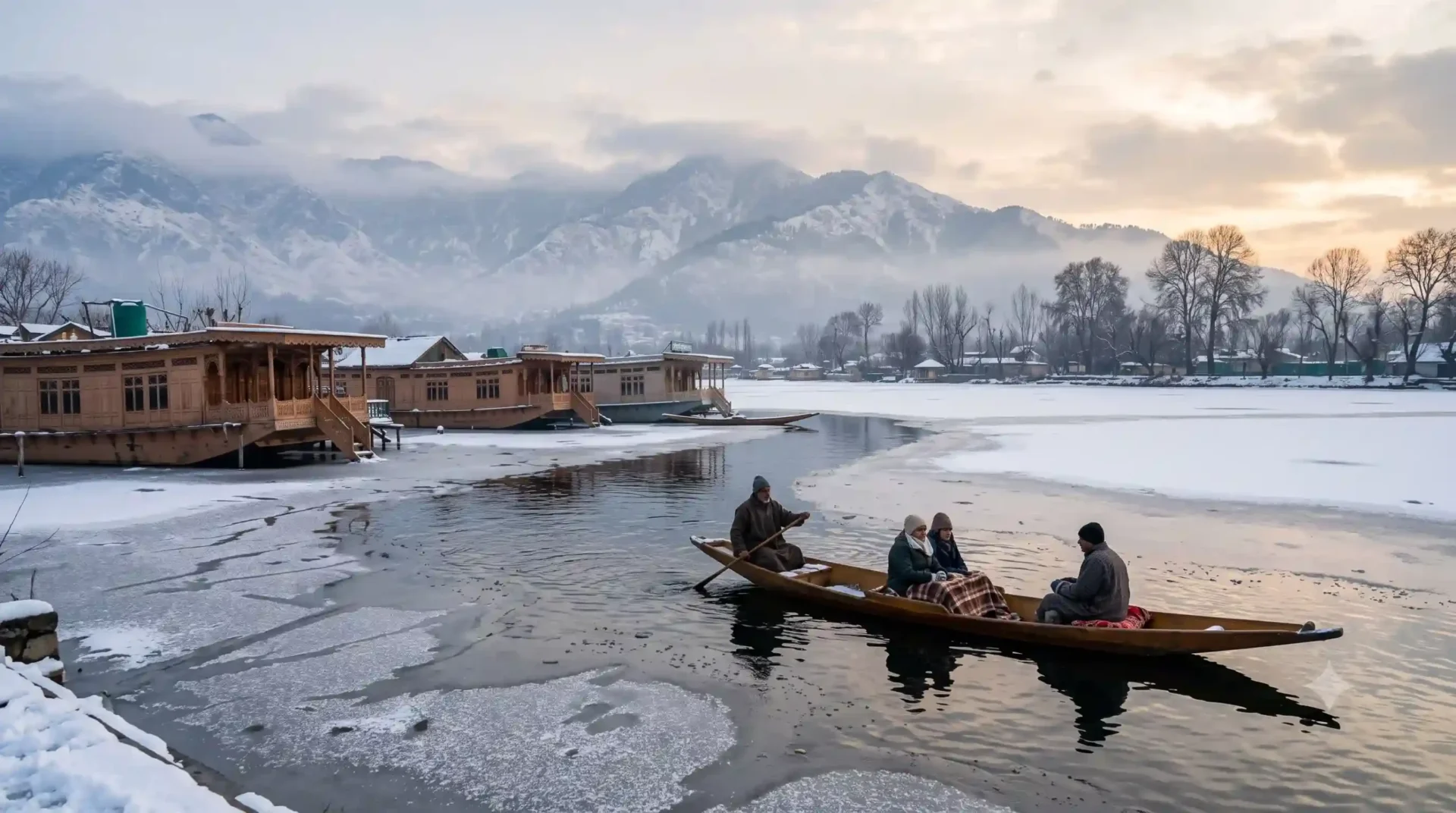
Every winter, photos of a frozen Dal Lake do the rounds — a shikara stuck mid-ice, a boy in a pheran standing on a white sheet of water where there should be open lake. It’s real, but the reality is more specific than most articles let on. Dal Lake doesn’t turn into a solid ice rink most winters; what actually happens, and when, is worth knowing before you build a whole trip around seeing it. If you’re still deciding when to come at all, our guide to the best time to visit Kashmir for snowfall shows how the month-by-month conditions compare.
Does Dal Lake Actually Freeze Solid?
Rarely, and it’s genuinely notable when it happens. By historical record, Dal Lake has fully frozen over only a handful of times — 1959, 1962, 1964, and 1986 are the years usually cited, including one occasion when a vehicle was famously driven across the solid ice. That kind of complete freeze needs a sustained, severe cold snap, and a fully frozen Dal Lake isn’t something you can plan a trip around expecting to see.
What happens most winters instead is partial freezing — a thin sheet of ice along the shallower edges, the narrower channels between houseboats, and the quieter interior waterways, especially during Chillai Kalan, the harshest 40-day stretch of the Kashmiri winter from December 21 to January 31. Even in a partial year, the ice at the edges makes for a striking scene — the open, deeper parts generally stay liquid even when the margins ice over. In the winter of 2024–25, for example, a cold wave that took Srinagar down to around −7°C left the lake partially frozen, with shikaras caught in the ice at the margins.
When You’re Most Likely to See a Frozen Dal Lake
- Late December through January, and especially during Chillai Kalan, is when a partially frozen Dal Lake is most likely. In some years a hard early cold wave has brought ice on the lake even around December 20, before Chillai Kalan officially begins.
- A sustained cold wave matters more than the calendar date — a week of nights well below freezing produces visible ice faster than a slow, mild December. As a rough guide, several consecutive nights of around −4°C to −6°C in Srinagar is what tends to produce visible ice on the channels and edges.
- Early morning is when the ice is thickest and most visible; it often thins or breaks up by midday as the sun comes up over the valley.
None of this is guaranteed on any specific date — Kashmir’s winters vary year to year, and we check current conditions before telling any guest what to expect on their travel dates.
Do Shikara Rides Still Run on a Frozen Dal Lake?
Yes, generally. Local boatmen keep channels open by breaking through the thin edge ice where houseboats and shikara routes need clear water, and the main open sections rarely ice over enough to stop boat traffic. A shikara cutting a single dark path through a frozen Dal Lake is, if anything, one of the more striking versions of the ride rather than a reason it gets cancelled. In a prolonged, severe cold spell, though, boatmen have warned that paddles alone may struggle to break the ice, so rides can slow down or pause on the very coldest mornings. It’s worth keeping your plans flexible on those days.
Is It Safe to Walk on a Frozen Dal Lake?
No — and this matters enough to say plainly. Authorities have repeatedly warned against walking or playing on frozen sections of Dal Lake after incidents of people, including groups playing cricket on the ice, risking falls through thin sections. During cold waves, the SDRF and river police have also patrolled around the frozen water to keep people off it. Ice thickness is inconsistent and can look solid while being unsafe in patches. Admire it from a shikara or the shoreline, not by walking out onto it.
Staying on a Houseboat Beside a Frozen Dal Lake
A winter houseboat stay here is one of the more atmospheric ways to experience it — carved wood interiors, a private deck, and genuinely cold air outside make the warmth inside feel earned. Ask specifically for a boat with a hamam (a traditional heated space) or modern room heaters, since not every houseboat is equally set up for winter comfort. Our heritage houseboat stay guide covers the categories and what to look for regardless of season, and if you’d rather book straight away, see our Dal Lake luxury houseboat packages.
What to Wear and Carry to See a Frozen Dal Lake
Mornings on the lake are the coldest part of any winter day, so dress for it: thermal base layers, a proper insulated jacket, waterproof boots with grip, gloves, and a warm cap. Carry a flask of kahwa if you can, and a camera or phone that copes with the cold, since batteries drain faster. Our Kashmir winter packing guide breaks down exactly what to bring for a trip like this.
Other Winter Sights Around Srinagar
A frozen or partially frozen Dal Lake is usually paired with a wider winter Srinagar itinerary:
- Hazratbal Shrine, on the northern bank, is especially striking with snow on its white marble against the water
- Mughal Gardens (Shalimar Bagh, Nishat Bagh) under a light snow cover, quiet and mostly free of summer crowds. For official information on Srinagar’s gardens and sights, the J&K Tourism website is a good starting point.
- Nigeen Lake, next to Dal, tends to be even quieter and often shows ice at its edges before Dal does
If you’re planning around Gulmarg’s ski season, our guide to planning a winter ski trip to Gulmarg covers pairing a Srinagar stay with the slopes, and travelers timing a holiday visit should see our Christmas and New Year in Kashmir package. If winter isn’t your season, Srinagar has a very different lakeside highlight in spring: the Tulip Garden Srinagar overlooks Dal Lake for a few weeks every March and April. For the bigger picture across all seasons, our ultimate Kashmir travel guide 2026 is the place to start.
Frequently Asked Questions About the Frozen Dal Lake
Does Dal Lake freeze every year?
Not fully. Most winters bring partial freezing along the edges and narrow channels, especially during Chillai Kalan. A complete freeze is rare.
When did Dal Lake last freeze completely?
The years usually cited in records are 1959, 1962, 1964, and 1986. A full freeze needs a sustained, severe cold snap and can’t be planned around.
When is the best time to see a frozen Dal Lake?
Late December through January, and especially early morning during a cold wave. A run of nights well below freezing matters more than the exact date.
Can you walk on a frozen Dal Lake?
No. Authorities have issued repeated advisories against it, because ice thickness is uneven and can look solid while being unsafe.
Do shikara rides run when Dal Lake is frozen?
Generally yes, because boatmen break the thin ice to keep routes open. In a prolonged severe cold spell, rides can slow down or pause on the coldest mornings.
Are houseboats open in winter?
Yes, but comfort varies. Ask for a boat with a hamam or reliable heaters.
What if Dal Lake isn’t frozen when I visit?
You’ll still get snow-dusted shorelines, misty mornings, and the quiet winter version of the lake without summer crowds, which many visitors find more memorable than the ice itself.
Why Book This Trip With Us
Timing a winter Srinagar visit depends on getting the dates right, and we track ground conditions daily rather than quoting a generic “December to February” window. We arrange heated houseboat stays with hamams confirmed in advance, not just booked and hoped for, and our drivers know which shikara routes stay open through the coldest stretches. Check our reviews on Google, or browse our full range of Kashmir tour packages to build a winter Srinagar stay into a bigger trip.
Frequently Asked Questions
Does Dal Lake freeze every winter?
No — a fully frozen Dal Lake is rare, recorded only a handful of times historically. A partially frozen Dal Lake at the edges and in quieter channels is common most winters, especially during Chillai Kalan.
Can I still take a shikara ride on a frozen Dal Lake?
Yes, usually. Boatmen keep the main channels clear by breaking through surface ice, and the open water generally stays liquid even when the margins freeze.
Is it safe to walk on a frozen Dal Lake?
No — authorities strictly advise against it, since ice thickness is inconsistent and can give way unexpectedly even where it appears solid.
What’s the best time to see a frozen Dal Lake?
Late December through January, particularly during a sustained sub-zero cold spell, and especially in the early morning before sunlight thins the ice out.
Want to time a Srinagar stay around a frozen Dal Lake? Message us on WhatsApp and we’ll tell you honestly what to expect for your dates, rather than promising ice we can’t guarantee.