
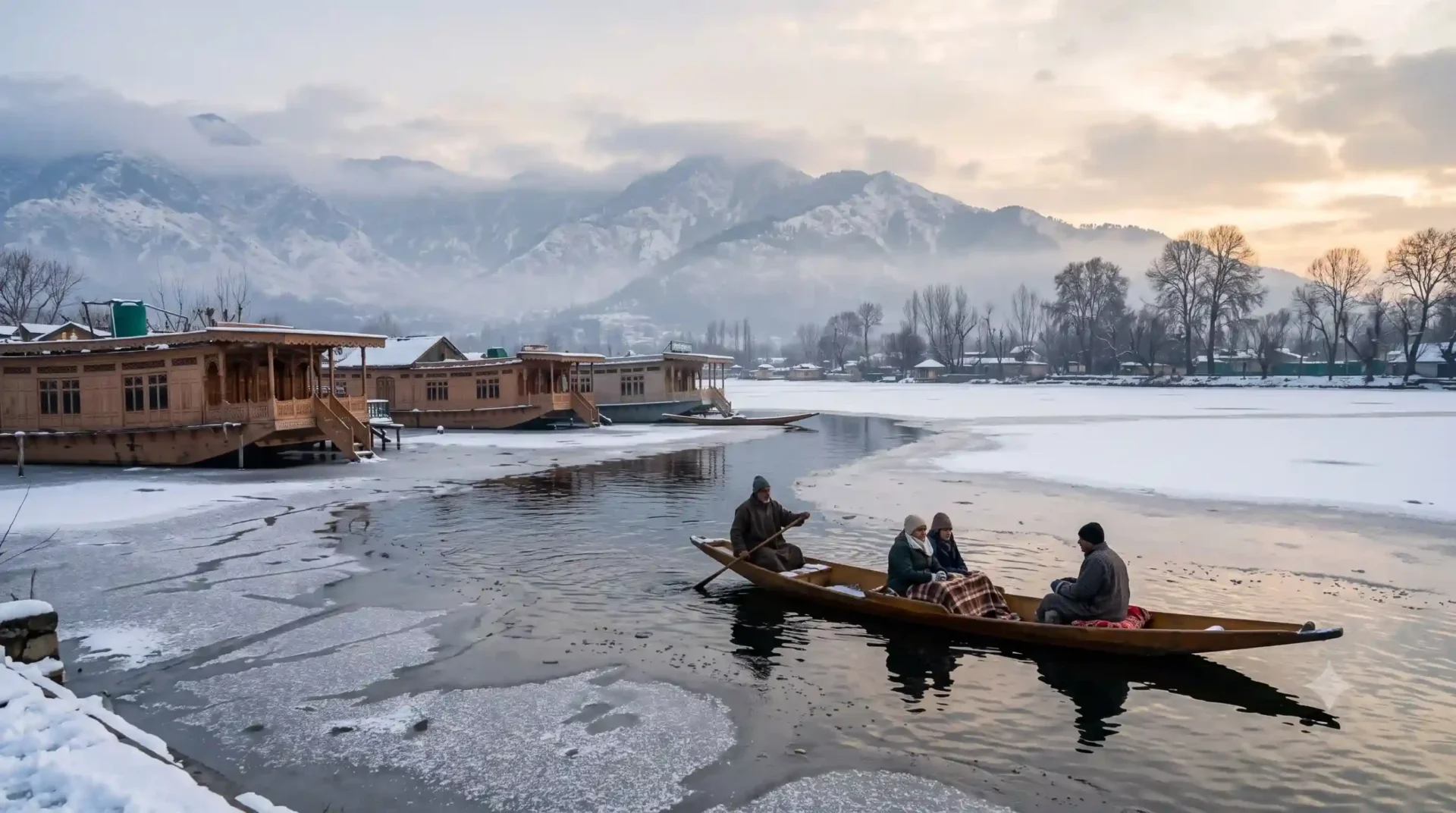
Every winter, photos of a frozen Dal Lake go viral: a shikara stuck in ice, or someone standing on a white sheet of water. The Frozen Dal Lake photos go viral every winter: a shikara stuck in ice, or someone standing on a white sheet of water. The photos are real, but Dal Lake does not turn into an ice rink every year. This guide explains when a frozen Dal Lake is likely, what recent winters looked like, and what you can safely expect on your trip.
We are a local Srinagar operator, so we have kept this practical: dates, temperatures, costs, safety and tips for seeing a frozen Dal Lake without risk. If you are still choosing your month, our guide to the best time to visit Kashmir for snowfall shows how conditions compare from December to March, and our month-by-month look at Kashmir in winter covers the wider picture.
Frozen Dal Lake Quick Facts
Short answer: a full freeze is very rare, but a partly frozen Dal Lake is likely in cold years, mostly from late December to January. Enjoy it from a shikara or the shore and never walk on the ice.
| Detail | What to know |
|---|---|
| Full freeze | Very rare. 1986 is the best-documented year, and a 1960s freeze is reported as 1964 or 1965 |
| Partial freeze | Happens in cold years, mostly on the edges, shallow parts and narrow channels |
| Best weeks to see a frozen Dal Lake | Chillai Kalan, and mainly the second and third weeks of January |
| Chillai Kalan 2026-27 | December 21, 2026 to about January 30, 2027 |
| Night temperature that tends to bring ice | Several nights of about -4 C to -6 C in Srinagar |
| Best time of day | Sunrise to about 9 AM, before the sun thins the ice |
| Safe to walk on a frozen Dal Lake | No. Ice is thin and uneven, and no official thickness figure is published |
| Shikara rides | Usually run, but may slow down or pause on the coldest mornings |
| Suggested stay | 2 to 3 nights in Srinagar, with flexible dates |
Does a Frozen Dal Lake Happen Every Winter?
Not a fully frozen one. By historical record, Dal Lake has frozen over completely only a handful of times. The best-documented year is 1986, when people played ice hockey and cricket on the surface. Local reports also mention a full freeze in the 1960s, when a jeep was driven across the ice. That kind of freeze needs a long, severe cold snap, so you cannot plan a trip around expecting it.
What happens in most cold winters is partial freezing. A thin sheet of ice forms along the shallow edges, in the narrow channels between houseboats and in the quieter inner waterways. The deeper open water usually stays liquid even when the margins ice over. The lake is split into basins, and the shallow, sheltered parts freeze first. So the frozen Dal Lake in viral photos is usually edge ice, not the whole lake.
Even a partly frozen Dal Lake makes a striking scene. In the winter of 2024-25, a cold wave that took Srinagar to about -7 C left the lake partly frozen, with shikaras caught in the ice at the edges. In early January 2026, a cold spell with lows near -6 C did the same, and boatmen used oars and sticks to break the crust.
For context, the weather office’s lowest recorded minimum in Srinagar is -14.4 C, set in 1893. In January 2021 the city dropped to -8.4 C, its coldest night since 1991, when it touched -11.8 C. Most winters are far milder than that. You can follow current forecasts on the India Meteorological Department website.
How Ice Forms on a Frozen Dal Lake
Ice depends on three things: how cold the night is, how many nights in a row stay cold, and how still the water is. Moving or deep water takes much longer to freeze than a shallow, sheltered channel.
That is why the edges and the lanes between houseboats freeze before the open basins. It is also why a single cold night rarely does much. A week of freezing nights does.
Here is a rough guide to what a frozen Dal Lake looks like at different night lows. These ranges come from news reports of past winters, not from a fixed rule.
| Srinagar night low | What people usually see |
|---|---|
| 0 C to -3 C | Frost on boats, decks and the shoreline. Thin ice in small, still pockets (one report showed frozen rivulets near -3 C) |
| -4 C to -6 C | Visible ice on the edges and channels. Boatmen start breaking ice to move |
| -7 C and lower | Wider ice, frozen taps and pipes on the lake, and people stepping on the ice despite warnings (January 2021) |
When Does Dal Lake Freeze? The Best Weeks to See a Frozen Dal Lake
Late December through January, and especially Chillai Kalan, is when a partly frozen Dal Lake is most likely. Chillai Kalan is the 40-day stretch of the harshest cold. In 2026-27 it runs from December 21 to about January 30. It is followed by Chillai Khurd (January 31 to February 19) and Chillai Bachha (February 20 to March 2). Our Chillai Kalan guide explains each period, with weather and road notes.
A sustained cold wave matters more than the calendar date. In some years a hard early cold wave has brought ice to the lake around December 20, before Chillai Kalan starts. In other years the whole of December stays too mild.
| Window | Chance of ice | What to know |
|---|---|---|
| December 1 to 20 | Low | Possible only after an early hard cold wave. See our Kashmir in December guide |
| December 21 to January 10 | Moderate in cold years | Peak crowds and prices; hotel gala dinners on December 24/25 and December 31 are usually compulsory |
| January 11 to 30 | Highest | Often the coldest nights of the year |
| January 31 to February 19 | Possible after cold nights | Fewer visitors, still cold mornings. See Kashmir in February |
| Late February to March | Unlikely | Snow on the hills, but the lake is mostly open |
If seeing a frozen Dal Lake matters to you, plan for the second and third weeks of January and keep your dates flexible. None of this is guaranteed on a given date. Kashmir’s winters change from year to year, and we check current conditions before we tell any guest what to expect.
Dal Lake in Winter: What to Expect Without Ice
Many guests ask about Dal Lake in winter as a whole, not only the ice. In November the lake is cold and quiet and ice is very unlikely, while the chinar leaves and early snow on the peaks do the work. From December the air turns sharp, mornings bring mist and frost, and the first thin edge ice becomes possible after a hard cold spell. By late February the lake mostly opens up again, and spring colour follows.
On a day with no ice at all, the lake still gives you mirror-flat water at sunrise, steam rising off the surface, snow-dusted mountains behind the Boulevard and almost no queue for a shikara. So treat a frozen Dal Lake as a bonus on top of a good winter trip, not the only reason to come.
Frozen Dal Lake Year by Year
These are recent winters when local news reported ice on the lake. Each time, a frozen Dal Lake followed a stretch of cold nights, usually around -5 C or colder in Srinagar.
| Winter | What was reported | Srinagar low |
|---|---|---|
| 2020-21 | Parts of the lake frozen; people seen stepping on the ice despite warnings | About -7.8 C to -8.4 C in mid-January |
| 2023-24 | Partial freezing; boatmen struggled to row | -4.8 C |
| 2024-25 | Thin ice that shikaras broke through as they moved | About -7 C in early January, -5.1 C on 12 January |
| 2025-26 | Lake partly frozen during a dry spell; shikaras and houseboats caught in ice | -5.7 C on 10 January |
Ice is common in cold years, but a full freeze is not. No full freeze has been reported since 1986.
An important lesson from 2025-26: that cold spell was dry. Early January 2026 was forecast to have no snow for about three weeks, yet the lake still froze at the edges. Ice and snow do not always arrive together, so do not assume a snowy trip will also be an icy one, or the other way round.
Can You Visit Dal Lake in Winter to See a Frozen Dal Lake?
Yes. You can visit Dal Lake on any day of the winter, frozen or not. Shikaras run, houseboats are open, and the snow-dusted shoreline is worth the trip on its own. What you cannot do is count on a frozen Dal Lake on one particular date. Seeing one is a bonus, not a promise.
A few habits make the visit better:
- Go at sunrise. Ice is thickest and most visible early in the morning, and it often thins or breaks by midday.
- Stay close to the lake. A houseboat or lakeside hotel lets you see first light without a cold early drive.
- Give yourself two to three nights. One clear morning is not enough, so extra nights give you more than one chance at a frozen Dal Lake.
- Keep flights flexible. Fog and snow can delay flights in cold spells, so avoid tight connections.
- Have a backup. If the lake stays liquid, snow in Gulmarg is the next best thing. Our Gulmarg travel guide covers it.
Do Shikara Rides Still Run on a Frozen Dal Lake?
Generally, yes. Local boatmen keep the main lanes open by breaking through thin edge ice wherever houseboats and shikara routes need clear water. The open sections rarely ice over enough to stop boat traffic. A shikara cutting one dark path through a frozen Dal Lake is, if anything, one of the more striking versions of the ride.
In a long, severe cold spell, though, boatmen have said that paddles alone can struggle to break the ice. Rides can slow down or pause on the very coldest mornings. Some houseboats also need a shikara transfer from the ghat, so ask how your transfer works if the lake is icy.
Two practical points:
- Price. One 2026 guide reports a government-fixed rate of about Rs 770 to Rs 790 per hour for a shikara carrying up to four people. We could not confirm this from an official list, so treat it as a guide. Agree the price and route before you board.
- Timing. The same guide says shikaras generally run from about 6 AM to 6 PM. Winter hours may be shorter, so check with your houseboat or hotel.
Is It Safe to Walk on a Frozen Dal Lake?
No, and this matters enough to say plainly. Authorities have repeatedly warned people not to walk or play on frozen sections of the lake. In cold years, tourists and locals, including groups playing cricket, have been seen on the ice. Ice thickness is uneven. A frozen Dal Lake can look solid and still give way in patches, and the water under it is freezing cold and deep in places.
Enjoy it from a shikara or from the shoreline. Do not let children or pets go onto the ice, and do not follow a crowd that has already stepped out. If someone falls through, do not run onto the ice after them. Call for help and reach out from solid ground. For wider winter risks, read our guide on whether Kashmir is safe in winter.
Staying on a Houseboat to See a Frozen Dal Lake
A winter houseboat stay is one of the best ways to see a frozen Dal Lake at sunrise. The wood-carved rooms, the private deck and the cold air outside make the warmth inside feel earned. Waking up beside a frozen Dal Lake with a cup of kahwa in your hands is the picture most guests remember.
Winter comfort differs a lot between boats, so ask these questions before you pay:
- Heating. Ask whether the boat has central heating, a hamam (a traditional heated space) or a bukhari, and whether heater use is billed extra.
- Hot water. Pipes can freeze on cold nights. Ask how hot water works in the morning.
- Power. Power cuts are possible in heavy snow or cold waves. Ask about backup.
- Transfers. Confirm whether you reach the boat by road or by shikara, and which ghat.
- Safety. Never sleep with a charcoal fire in a closed room. Keep a window slightly open when a bukhari is burning.
Houseboat prices vary widely, and rates usually fall in winter compared with the high season. Reported nightly rates run from about Rs 4,000 to Rs 7,000 for budget boats to about Rs 8,000 to Rs 15,000 for premium ones, with luxury boats higher. Sources differ, so treat these as a guide. Our heritage houseboat stay on Dal Lake guide explains the categories, and you can book straight away through our Dal Lake luxury houseboat packages.
A Flexible 4-Day Plan Built Around a Frozen Dal Lake
The best plan gives you two sunrises on a frozen Dal Lake, so one cold morning is not your only chance. This sample suits January travel.
- Day 1: Arrive in Srinagar and check in to your houseboat or lakeside hotel. Take an easy sunset shikara ride and rest early.
- Day 2: Be on the water at sunrise. After breakfast, visit Hazratbal Shrine and the Mughal Gardens, then walk the Boulevard in the afternoon.
- Day 3: Day trip to Gulmarg for snow, or a quiet day in Srinagar if the roads are icy. Return by late afternoon, because winter days are short. Our Gulmarg Gondola ticket booking guide explains how to plan the ride.
- Day 4: One more sunrise on the lake, then head to the airport with plenty of time. Fog can delay flights.
If snow or ice disrupts a day, swap days 2 and 3 rather than losing a day. Want a longer plan? Our Kashmir winter tour packages add Gulmarg and Pahalgam to a Srinagar stay, and our Srinagar, Gulmarg and Pahalgam tour package follows that route. If you are curious about the hill towns in winter, read our Pahalgam in winter guide and our Sonamarg in winter guide.
How to Photograph a Frozen Dal Lake
A few simple habits give far better pictures of a frozen Dal Lake. Shoot in the first hour after sunrise, when the light is low and the ice still shows its texture. Keep your phone or camera inside your jacket between shots, because cold drains batteries fast, and carry a power bank. Shoot from the shikara or the ghat, never from the ice, and ask your boatman to pause beside a clear channel so the broken ice leads the eye to the mountains. Lens wipes help, since mist settles on glass.
Costs and Booking Tips for a Frozen Dal Lake Trip
Think in separate lines: the houseboat or hotel, transfers, the shikara and food. Our land-only Kashmir packages start from about Rs 10,500 per person for 4 nights and 5 days, Rs 12,500 for 5 nights and 6 days, and Rs 15,500 for 6 nights and 7 days, on twin sharing. Premium and heritage stays begin around Rs 22,000. Dates from December 21 to January 10 cost more. These are starting prices, and the final quote depends on your dates and hotel. For a wider budget view, see our Kashmir trip cost for 5 days page and our luxury Kashmir tour packages.
Our usual terms are a 25% advance, 50% by 20 to 29 days before departure, and the balance 20 days before. Cancellations 30 or more days out carry a small fee. Between 20 and 30 days, 50% applies; between 10 and 19 days, 75%; and under 10 days, 100%. Refunds for weather or road closures depend on what the hotel or driver charges us. Ask any operator for these terms in writing.
Three booking tips help:
- Book your houseboat early for January, because the best boats fill first.
- Do not pay extra for a promised frozen Dal Lake. No operator can guarantee it.
- Choose a plan with a spare night, so one dull morning does not decide whether you see a frozen Dal Lake.
Plan this trip with local Srinagar experts Our Kashmir winter packages start from Rs 8,500 per person for 3 nights and 4 days, and from Rs 10,500 for 4 nights and 5 days (land-only, twin sharing, indicative). Tell us your dates and we send a plan and a fair quote, and we tell you about any cost change before we act. Tap the WhatsApp or call button on this page, or send us your trip dates. See our current winter packages and prices, our 3N/4D winter package or every package we run.
Frozen Dal Lake for Foreign Visitors: Visa, ID and Winter Tips
Guests from the UK, US, Australia, Canada, the Gulf, Malaysia and Singapore ask us the same thing each winter: will we see a frozen Dal Lake, and is the cold worth it? Our honest answer is that edge ice is likely in a cold January, a full freeze is not, and the lake is worth the trip either way. Many visitors from the Gulf and Southeast Asia come mainly for snow, so we pair the lake with Gulmarg, where snow is more likely than on the water, and with a night or two in Pahalgam.
Carry your original passport and a printout of your Indian visa or e-visa, and apply on the Indian e-Visa portal well before you fly. For the Gulmarg Gondola, the travel agency must email each visitor’s full name and passport number to the cable car office at least two days before the ride, so give us your passport details early.
Time your trip around Chillai Kalan, which runs from December 21 to about January 30. Nights are coldest, flights can be delayed by fog, and hotels charge peak rates in the Christmas and New Year window. Keep two spare days, and read our guide for overseas guests before you book. We never sell a promised freeze, only a flexible plan with a warm houseboat and a backup day.
Visiting from abroad? Plan it with a local Srinagar team Tell us your nationality, travel dates and group size. We tell you which ID, visa and permit steps apply to your passport, and we send a plan and an indicative quote in your currency range before you pay anything. We tell you about any cost change before we act. Tap the WhatsApp or call button on this page, or send your dates and passport country. See our guide for foreign tourists in Kashmir or our full list of packages.
What to Wear and Carry
Mornings beside a frozen Dal Lake are the coldest part of any winter day, so dress for them. Wear thermal base layers, an insulated jacket, waterproof boots with good grip, gloves and a warm cap. Carry a flask of kahwa if you can, and a phone or camera that copes with the cold, because batteries drain faster. A power bank helps. Our Kashmir winter packing guide breaks down what to wear, what to rent and what to leave at home. The best chances for a frozen lake fall in the coldest weeks, and our guide to Kashmir in January explains what else to expect that month.
Other Winter Sights Around Srinagar
A frozen or partly frozen Dal Lake is usually paired with a wider winter Srinagar plan:
- Hazratbal Shrine, on the northern bank, looks striking with snow on its white marble against the water.
- Mughal Gardens (Shalimar Bagh and Nishat Bagh) under a light snow cover are quiet and mostly free of summer crowds. For official information on Srinagar’s gardens and sights, the J&K Tourism website is a good starting point.
- Nigeen Lake, next to Dal, tends to be quieter and often shows ice at its edges before Dal does.
- Wular Lake, for a calmer lake day away from the city. Our Wular Lake guide covers what to expect.
- Gulmarg, for snow, the Gondola and skiing. If skiing is your main plan, our guide to planning a winter ski trip to Gulmarg covers lessons, gear and costs.
Travelling over the holidays? See our Christmas and New Year in Kashmir package for dates, gala dinners and peak surcharges.
Staying Safe in the Cold
- Ice: Never walk on a frozen Dal Lake, and keep children close on the ghats and decks.
- Slippery steps: Houseboat steps, ghats and the Boulevard can be icy. Wear boots with grip.
- Heaters: Ventilate any room with a bukhari or heater.
- Frozen pipes: Taps can freeze in a cold wave, so ask about water before you arrive.
- Cold exposure: Cover your hands, ears and face, and go inside if your fingers or toes go numb.
- Roads: Avoid night driving. Black ice forms fast after dark.
Who a Frozen Dal Lake Trip Is Not For
Being honest saves you money and a poor week.
- Anyone who needs to see a frozen Dal Lake on one fixed date. No operator can promise it.
- Travellers who dislike very cold mornings. Sunrise on the lake is the best time and also the coldest.
- Guests who want a packed sightseeing schedule. A flexible plan with spare mornings works better.
- People who cannot manage icy steps and boat transfers, such as some older guests, unless the stay has road access.
- Budget travellers who want peak-season prices. The December 21 to January 10 window costs the most.
Common Mistakes to Avoid
- Booking only one night, so one mild morning decides whether you see a frozen Dal Lake at all.
- Choosing a houseboat without asking about heating and hot water.
- Walking on the ice for a photo.
- Planning a tight flight on the day you leave, when fog is common.
Other Seasons on the Same Lake
If a frozen Dal Lake is not your goal, the lake looks just as good at other times. See the Tulip Garden in Srinagar in spring, when it overlooks the lake for a few weeks every March and April. For golden chinar colours, read about autumn in Kashmir. For the bigger picture across all seasons, our ultimate Kashmir travel guide 2026 is the place to start.
Plan Your Frozen Dal Lake Trip With Us
If you want a houseboat night, a shikara ride, a Gulmarg day and flexible dates built into one plan, tell us your travel dates and group size and we will send a clear quote with written inclusions and terms. You can ask for a customized Kashmir holiday package, use our Kashmir tour package booking page, or browse all our Kashmir tour packages and Kashmir destinations. You can also read what past travellers say on our Google Business profile. Whatever you choose, leave room in your plan for the weather, because that is what decides whether you see a frozen Dal Lake or not. Our top 30 Kashmir travel FAQs can help you fold the Srinagar stay into a bigger trip.
Frequently Asked Questions About the Frozen Dal Lake
Does Dal Lake freeze every year?
Not fully. Most winters bring partial freezing along the edges and narrow channels, especially during Chillai Kalan. A complete freeze is rare.
When did Dal Lake last freeze completely?
The years usually cited in records are 1959, 1962, 1964, and 1986. A full freeze needs a sustained, severe cold snap and can’t be planned around.
When is the best time to see a frozen Dal Lake?
Late December through January, and especially early morning during a cold wave. A run of nights well below freezing matters more than the exact date.
Can you walk on a frozen Dal Lake?
No. Authorities have issued repeated advisories against it, because ice thickness is uneven and can look solid while being unsafe.
Do shikara rides run when Dal Lake is frozen?
Generally yes, because boatmen break the thin ice to keep routes open. In a prolonged severe cold spell, rides can slow down or pause on the coldest mornings.
Are houseboats open in winter?
Yes, but comfort varies. Ask for a boat with a hamam or reliable heaters.
What if Dal Lake isn’t frozen when I visit?
You’ll still get snow-dusted shorelines, misty mornings, and the quiet winter version of the lake without summer crowds, which many visitors find more memorable than the ice itself.
Does Dal Lake freeze every winter?
No — a fully frozen Dal Lake is rare, recorded only a handful of times historically. A partially frozen Dal Lake at the edges and in quieter channels is common most winters, especially during Chillai Kalan.
Can I still take a shikara ride on a frozen Dal Lake?
Yes, usually. Boatmen keep the main channels clear by breaking through surface ice, and the open water generally stays liquid even when the margins freeze.
Is it safe to walk on a frozen Dal Lake?
No — authorities strictly advise against it, since ice thickness is inconsistent and can give way unexpectedly even where it appears solid.
What’s the best time to see a frozen Dal Lake?
Late December through January, particularly during a sustained sub-zero cold spell, and especially in the early morning before sunlight thins the ice out.
Want to time a Srinagar stay around a frozen Dal Lake? Message us on WhatsApp and we’ll tell you honestly what to expect for your dates, rather than promising ice we can’t guarantee.